

This store requires javascript to be enabled for some features to work correctly.


$54.00 AUD
Regular price $49.00 AUDNot sure where to start? Start here.
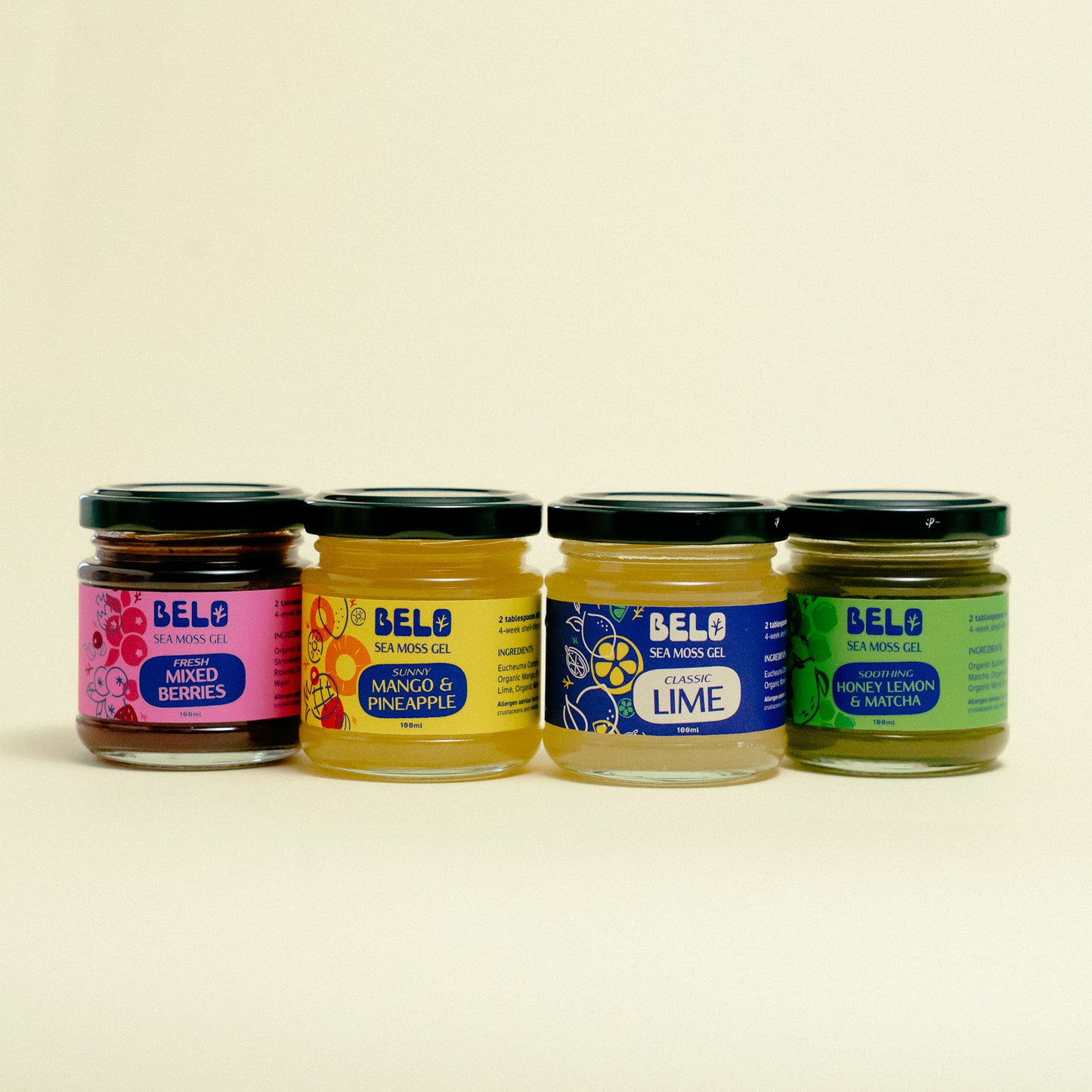
4 flavours. One daily spoonful, find your favourite before committing to a full-size jar.
Real food. No nasties. Proven over generations.
ry all 4 flavours for 30 days. Don't love it — full refund. No returns. No questions


Sea Moss is one of the ocean’s most nutrient-rich plants.
Native to the tropical waters of South East Asia and the Pacific Islands, our variety, Eucheuma cottonii, is a type of seaweed known for its natural gelatinous texture. We source ours from the most biodiverse reefs in the world.
Beyond its unique consistency, sea moss is valued for its naturally occurring minerals and nutrients.
At Belo, we use a gentle soaking and blending process to preserve these natural qualities, creating a convenient gel that can be easily added to smoothies, breakfasts, or snacks as part of your daily routine.
Sea Moss is one of the ocean’s most nutrient-rich plants.
Native to the tropical waters of South East Asia and the Pacific Islands, our variety, Eucheuma cottonii, is a type of seaweed known for its natural gelatinous texture. We source ours from the most biodiverse reefs in the world.
Beyond its unique consistency, sea moss is valued for its naturally occurring minerals and nutrients.
At Belo, we use a gentle soaking and blending process to preserve these natural qualities, creating a convenient gel that can be easily added to smoothies, breakfasts, or snacks as part of your daily routine.
Try Belo for 30 days. If you don't notice a difference, contact us and we'll refund your order in full
Try Belo for 30 days. If you don't notice a difference, contact us and we'll refund your order in full
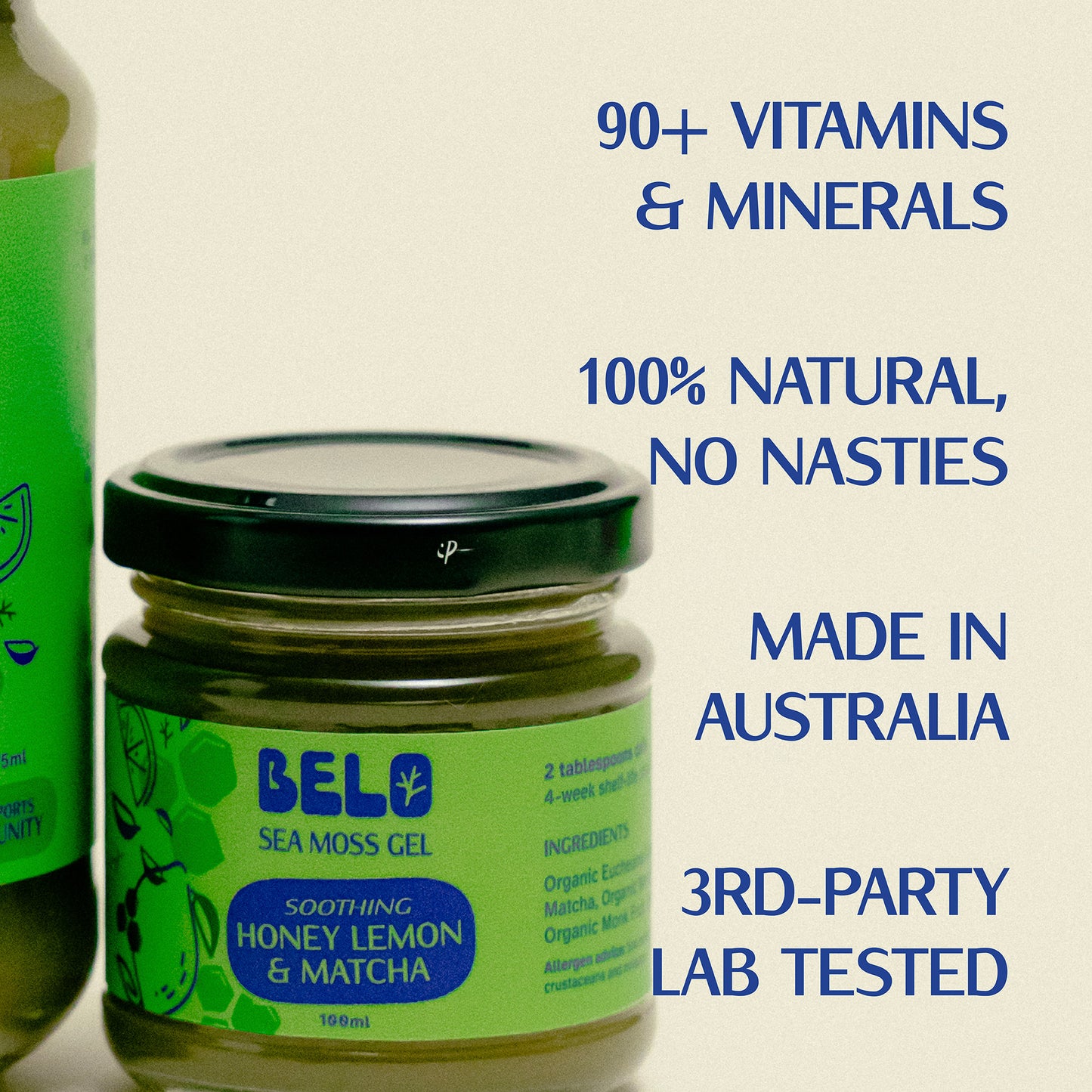
Belo Sea Moss Gels contain no additives, preservatives, or artificial flavours.
Each blend is made from organic sea moss and natural wholefood ingredients.
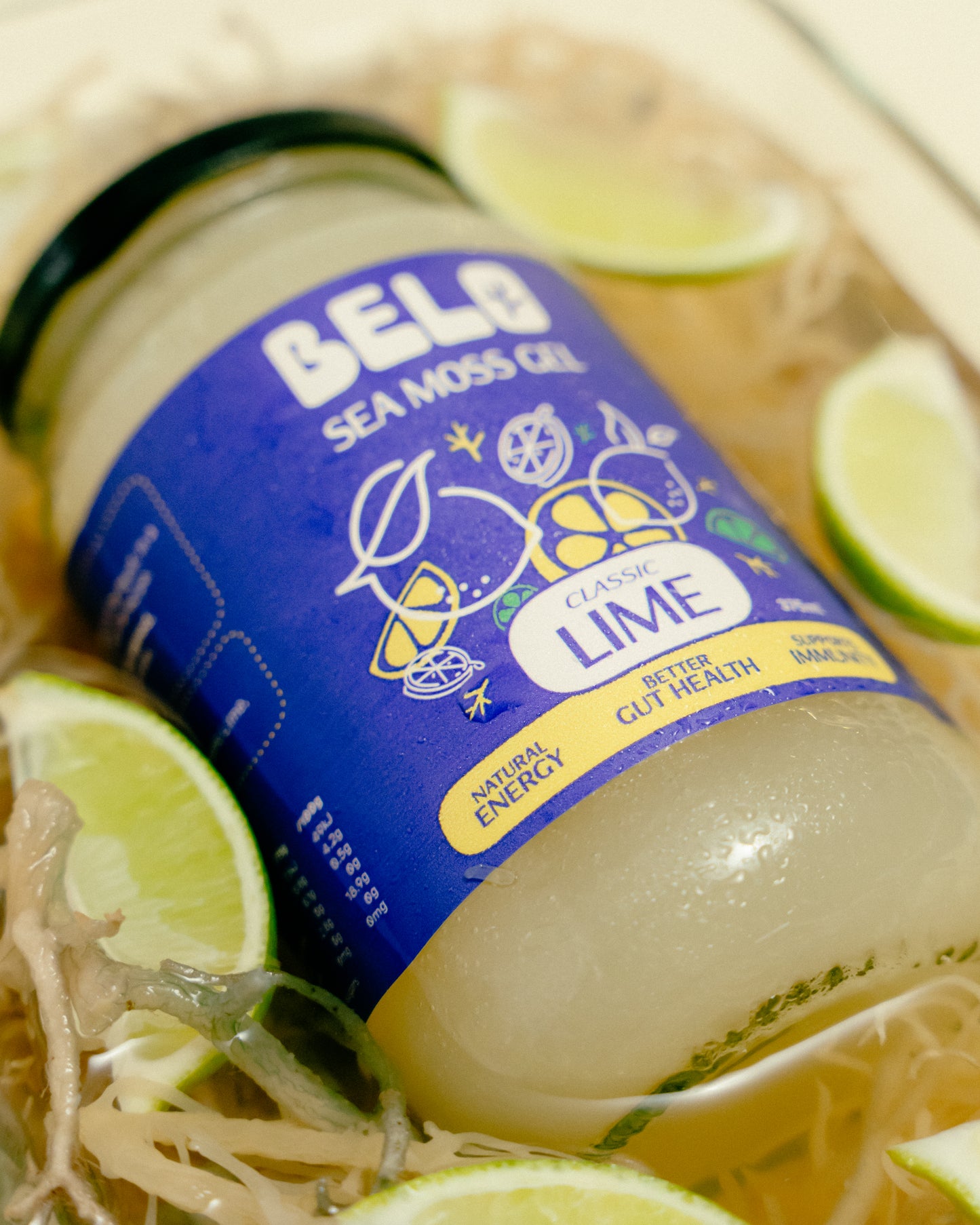
Classic Lime: Organic Gold Sea Moss, Organic Whole Lime, Organic Monk Fruit, Filtered Water
Sunny Mango & Pineapple: Organic Gold Sea Moss, Organic Sea Moss, Organic Mango, Organic Pineapple, Organic Whole Lime, Organic Certified Monk Fruit Blend, Filtered Water
Fresh Mixed Berries: Organic Gold Sea Moss, Organic Strawberries, Organic Blueberries, Australian Rosella, Organic Certified Monk Fruit Blend, Filtered Water
Honey Lemon & Matcha: Organic Gold Sea Moss, Organic Matcha, Organic Moringa, Marri Honey, Organic Certified Monk Fruit Blend, Filtered Water
Curious about our nutritional profile? Our FAQ
Belo Sea Moss Gels contain no additives, preservatives, or artificial flavours.
Each blend is made from organic sea moss and natural wholefood ingredients.
Classic Lime: Organic Gold Sea Moss, Organic Whole Lime, Organic Monk Fruit, Filtered Water
Sunny Mango & Pineapple: Organic Gold Sea Moss, Organic Sea Moss, Organic Mango, Organic Pineapple, Organic Whole Lime, Organic Certified Monk Fruit Blend, Filtered Water
Fresh Mixed Berries: Organic Gold Sea Moss, Organic Strawberries, Organic Blueberries, Australian Rosella, Organic Certified Monk Fruit Blend, Filtered Water
Honey Lemon & Matcha: Organic Gold Sea Moss, Organic Matcha, Organic Moringa, Marri Honey, Organic Certified Monk Fruit Blend, Filtered Water
Curious about our nutritional profile? Our FAQ
Add a spoonful to your smoothie, breakfast bowl, or can even be enjoy by the spoon like a jam!
Add a spoonful to your smoothie, breakfast bowl, or can even be enjoy by the spoon like a jam!
At Belo, we believe you should never have to take a wellness brand's word for it. This page holds our independent laboratory results — heavy metals, iodine, microbiology, gluten and mineral testing — published openly, with the lab, accreditation number, report number and date for every result. We update it as new reports arrive.
Belo sea moss gels are made in Australia from Kappaphycus alvarezii (commercially known as "Eucheuma cottonii", or gold sea moss), grown on sustainable ocean-based farms in Saint Lucia and Timor-Leste. The species is identified on the Saint Lucia phytosanitary certificate accompanying our raw material.
All results on this page come from independent, accredited laboratories:
Agrifood Technology (AWTA) — NATA accreditation #2726.
Mérieux NutriSciences — NATA accreditation #345.
National Measurement Institute (NMI) — ISO/IEC 17025, accreditation #198.
NATA is Australia's national laboratory accreditation authority — you can verify any accreditation number at nata.com.au. Every report cited below is available as a complete, redacted PDF at the link in its section.
Lab: Agrifood Technology (AWTA), NATA #2726. Report: B2601-0284. Issued: 2 March 2026. Sample: raw sea moss.
| Analyte | Result (mg/kg) | FSANZ Food Standards Code maximum level |
|---|---|---|
| Inorganic arsenic† | <0.020 | 1 mg/kg — result is more than 50× below |
| Organic arsenic | 0.18 | No ML — the seaweed limit applies to inorganic arsenic |
| Cadmium | 0.014 | No ML specified for seaweed in Schedule 19 |
| Mercury | <0.010 | No ML specified for seaweed in Schedule 19 |
† The arsenic speciation method (which separates inorganic from organic arsenic) sits outside the laboratory's NATA scope of accreditation. We disclose this because we would rather over-explain than gloss over it.
The same report includes a pesticide residue screen of approximately 150 analytes. All were Not Detected.
Full redacted report (PDF) — Report 474989, Job B2601-0284
Lab: Agrifood Technology (AWTA), NATA #2726. Report: B2307-0129. Dated: 14 July 2023. Sample: Classic ("Classic 1").
| Analyte | Result (mg/kg) | FSANZ Food Standards Code maximum level |
|---|---|---|
| Arsenic (total) | 0.076 | Seaweed ML (1 mg/kg) applies to inorganic arsenic; total shown for transparency |
| Cadmium | <0.010 | No ML specified for seaweed in Schedule 19 |
| Chromium | <0.010 | No ML specified for seaweed in Schedule 19 |
| Copper | <0.10 | No ML specified for seaweed in Schedule 19 |
| Lead | <0.010 | No ML specified for seaweed in Schedule 19 |
| Mercury | <0.010 | No ML specified for seaweed in Schedule 19 |
| Aluminium | <2.0 | No ML specified for seaweed in Schedule 19 |
Full redacted report (PDF) — Report 232062, Job B2307-0129
Lab: Agrifood Technology (AWTA), NATA #2726 (NATA-accredited result). Report: B2603-0422. Issued: 25 March 2026. Sample: finished Classic gel.
Lead: <0.010 mg/kg.
Full redacted report (PDF) — Report 482039, Job B2603-0422 (lead + gluten panel)
Maximum levels (ML) are from Schedule 19 of the Australia New Zealand Food Standards Code (see also FSANZ on arsenic in food). The seaweed ML for inorganic arsenic is 1 mg/kg, calculated on seaweed at 85% hydration. Where the Code sets no seaweed-specific ML for a metal, we publish our result anyway.
Lab: Mérieux NutriSciences, NATA #345 — Certificate of Analysis MNAQW25013679-06575961-F, issued 17 January 2026. Analysis performed by the National Measurement Institute (ISO/IEC 17025, accreditation #198) under subcontract report MNAQW25013679. Sample: "BL2002 Belo Sea Moss Gel (Liquid)".
Iodine: 13 mg/kg on a dry weight basis.
Full redacted Certificate of Analysis (PDF) — Mérieux NutriSciences · Full redacted NMI analysis report (PDF)
Dry weight basis means the result is measured on the sample with its water removed, so it reads higher than what you would consume in the finished gel, which is mostly water.
In 2026, samples of Belo sea moss gel purchased independently at retail were assessed by the Western Australian Department of Health. Measured iodine in the finished gel: 0.66 mg/kg (Honey) and 1.1 mg/kg (Lime).
| Measure | Value | Context |
|---|---|---|
| Iodine per 15 g serve | approx. 10–17 µg | Adult Recommended Dietary Intake: 150 µg/day (FSANZ) |
| Iodine per recommended daily amount (2 tablespoons) | approx. 20–33 µg | Tolerable Upper Level: 1,100 µg/day (FSANZ) |
The toxicological assessment concluded that at these concentrations, daily consumption at the recommended amount is well below the upper level for the general population. Iodine content can vary between batches of any seaweed product — that variability is why we test, and why we are moving to batch-level testing.
Who should check with a doctor first: sea moss is naturally rich in iodine, and people with a thyroid condition (particularly hyperthyroidism), people taking thyroid-related medication, and people who are pregnant have increased sensitivity to iodine intake. This product is not appropriate for individuals with hyperthyroidism. Do not exceed the recommended amount, and consult a healthcare professional before use if any of these apply to you. We would rather lose a sale than have you guess.
Lab: Agrifood Technology (AWTA), NATA #2726. Job: B2503-0088. Sample: Sea Moss Blue (revised recipe), production date 4 March 2025. Testing at Day 30, Day 50 and Day 60 after production.
| Test | Day 30 (report 399055) | Day 50 (report 393164, interim) | Day 60 (report 399056) |
|---|---|---|---|
| Total plate count (cfu/g) | <10 | <10 | ~10 |
| Yeasts & moulds (cfu/g) | <100 | <100 | <100 |
| Coagulase-positive staphylococci (cfu/g) | — | — | <100 |
| E. coli (cfu/g) | — | — | <10 |
| Coliforms (cfu/g) | — | — | <10 |
| Listeria monocytogenes (per 25 g) | — | — | Not Detected |
| Salmonella (per 25 g) | — | — | Not Detected |
A dash (—) means that test was not part of that day's panel. The Day 60 test was the full pathogen panel; all results were clear.
Separately from the tested series above, our storage guidance as a brand is: keep Belo sea moss gel refrigerated at or below 5°C, use within 12 weeks unopened, and consume within 4 weeks once opened. This is Belo's stated shelf life guidance; the laboratory series above reports the microbiological data we hold at Day 30, Day 50 and Day 60.
Lab: Agrifood Technology (AWTA), NATA #2726. Job: B2603-0422. Issued: 25 March 2026. Samples: all flavours.
Gluten: Not Detected across all flavours, at a reporting limit of 5.0 mg/kg.
Method note: gluten was tested by ELISA, a method that sits outside the laboratory's NATA scope of accreditation. We disclose this so the result is read in full context.
Allergen statement (as it appears on our labels): May contain: crustacean, mollusc.
Full redacted report (PDF) — Report 482039, Job B2603-0422
Lab: Agrifood Technology (AWTA), NATA #2726. Report: B2510-0029 (final). Issued: 16 October 2025. Samples: across flavours.
Rather than making broad vitamin and mineral claims, here are the minerals we have actually measured in the finished gels. Ranges reflect variation across flavours.
| Mineral | Result across flavours (mg/kg) |
|---|---|
| Iron | 3.3–7.0 |
| Magnesium | 43–94 |
| Phosphorus | <20–110 |
| Zinc | <0.50–0.97 |
The same report measured dietary fibre in the Berries flavour: 1.9 g per 100 g.
Full redacted report (PDF) — final, Report 436417 · interim, Report 435674
Nutrition Information Panels for all five flavours were prepared using the FSANZ Nutrition Panel Calculator (reports dated 26 May 2025), stating energy, protein, fat, saturated fat, carbohydrate, sugars and sodium per 15 g serve and per 100 g. Energy per 100 g ranges from 7.9 kJ (Classic) to 58.5 kJ (Tropical). The full Nutrition Information Panel for each flavour appears on its product page.
Serving details: 15 g per serve, 24 serves per 375 ml jar. Store refrigerated at or below 5°C.
Where laboratory reports are linked on this page, they are reproduced in full as PDFs, with personal details redacted. We do not publish excerpts of reports out of context.
At Belo, we believe you should never have to take a wellness brand's word for it. This page holds our independent laboratory results — heavy metals, iodine, microbiology, gluten and mineral testing — published openly, with the lab, accreditation number, report number and date for every result. We update it as new reports arrive.
Belo sea moss gels are made in Australia from Kappaphycus alvarezii (commercially known as "Eucheuma cottonii", or gold sea moss), grown on sustainable ocean-based farms in Saint Lucia and Timor-Leste. The species is identified on the Saint Lucia phytosanitary certificate accompanying our raw material.
All results on this page come from independent, accredited laboratories:
Agrifood Technology (AWTA) — NATA accreditation #2726.
Mérieux NutriSciences — NATA accreditation #345.
National Measurement Institute (NMI) — ISO/IEC 17025, accreditation #198.
NATA is Australia's national laboratory accreditation authority — you can verify any accreditation number at nata.com.au. Every report cited below is available as a complete, redacted PDF at the link in its section.
Lab: Agrifood Technology (AWTA), NATA #2726. Report: B2601-0284. Issued: 2 March 2026. Sample: raw sea moss.
| Analyte | Result (mg/kg) | FSANZ Food Standards Code maximum level |
|---|---|---|
| Inorganic arsenic† | <0.020 | 1 mg/kg — result is more than 50× below |
| Organic arsenic | 0.18 | No ML — the seaweed limit applies to inorganic arsenic |
| Cadmium | 0.014 | No ML specified for seaweed in Schedule 19 |
| Mercury | <0.010 | No ML specified for seaweed in Schedule 19 |
† The arsenic speciation method (which separates inorganic from organic arsenic) sits outside the laboratory's NATA scope of accreditation. We disclose this because we would rather over-explain than gloss over it.
The same report includes a pesticide residue screen of approximately 150 analytes. All were Not Detected.
Full redacted report (PDF) — Report 474989, Job B2601-0284
Lab: Agrifood Technology (AWTA), NATA #2726. Report: B2307-0129. Dated: 14 July 2023. Sample: Classic ("Classic 1").
| Analyte | Result (mg/kg) | FSANZ Food Standards Code maximum level |
|---|---|---|
| Arsenic (total) | 0.076 | Seaweed ML (1 mg/kg) applies to inorganic arsenic; total shown for transparency |
| Cadmium | <0.010 | No ML specified for seaweed in Schedule 19 |
| Chromium | <0.010 | No ML specified for seaweed in Schedule 19 |
| Copper | <0.10 | No ML specified for seaweed in Schedule 19 |
| Lead | <0.010 | No ML specified for seaweed in Schedule 19 |
| Mercury | <0.010 | No ML specified for seaweed in Schedule 19 |
| Aluminium | <2.0 | No ML specified for seaweed in Schedule 19 |
Full redacted report (PDF) — Report 232062, Job B2307-0129
Lab: Agrifood Technology (AWTA), NATA #2726 (NATA-accredited result). Report: B2603-0422. Issued: 25 March 2026. Sample: finished Classic gel.
Lead: <0.010 mg/kg.
Full redacted report (PDF) — Report 482039, Job B2603-0422 (lead + gluten panel)
Maximum levels (ML) are from Schedule 19 of the Australia New Zealand Food Standards Code (see also FSANZ on arsenic in food). The seaweed ML for inorganic arsenic is 1 mg/kg, calculated on seaweed at 85% hydration. Where the Code sets no seaweed-specific ML for a metal, we publish our result anyway.
Lab: Mérieux NutriSciences, NATA #345 — Certificate of Analysis MNAQW25013679-06575961-F, issued 17 January 2026. Analysis performed by the National Measurement Institute (ISO/IEC 17025, accreditation #198) under subcontract report MNAQW25013679. Sample: "BL2002 Belo Sea Moss Gel (Liquid)".
Iodine: 13 mg/kg on a dry weight basis.
Full redacted Certificate of Analysis (PDF) — Mérieux NutriSciences · Full redacted NMI analysis report (PDF)
Dry weight basis means the result is measured on the sample with its water removed, so it reads higher than what you would consume in the finished gel, which is mostly water.
In 2026, samples of Belo sea moss gel purchased independently at retail were assessed by the Western Australian Department of Health. Measured iodine in the finished gel: 0.66 mg/kg (Honey) and 1.1 mg/kg (Lime).
| Measure | Value | Context |
|---|---|---|
| Iodine per 15 g serve | approx. 10–17 µg | Adult Recommended Dietary Intake: 150 µg/day (FSANZ) |
| Iodine per recommended daily amount (2 tablespoons) | approx. 20–33 µg | Tolerable Upper Level: 1,100 µg/day (FSANZ) |
The toxicological assessment concluded that at these concentrations, daily consumption at the recommended amount is well below the upper level for the general population. Iodine content can vary between batches of any seaweed product — that variability is why we test, and why we are moving to batch-level testing.
Who should check with a doctor first: sea moss is naturally rich in iodine, and people with a thyroid condition (particularly hyperthyroidism), people taking thyroid-related medication, and people who are pregnant have increased sensitivity to iodine intake. This product is not appropriate for individuals with hyperthyroidism. Do not exceed the recommended amount, and consult a healthcare professional before use if any of these apply to you. We would rather lose a sale than have you guess.
Lab: Agrifood Technology (AWTA), NATA #2726. Job: B2503-0088. Sample: Sea Moss Blue (revised recipe), production date 4 March 2025. Testing at Day 30, Day 50 and Day 60 after production.
| Test | Day 30 (report 399055) | Day 50 (report 393164, interim) | Day 60 (report 399056) |
|---|---|---|---|
| Total plate count (cfu/g) | <10 | <10 | ~10 |
| Yeasts & moulds (cfu/g) | <100 | <100 | <100 |
| Coagulase-positive staphylococci (cfu/g) | — | — | <100 |
| E. coli (cfu/g) | — | — | <10 |
| Coliforms (cfu/g) | — | — | <10 |
| Listeria monocytogenes (per 25 g) | — | — | Not Detected |
| Salmonella (per 25 g) | — | — | Not Detected |
A dash (—) means that test was not part of that day's panel. The Day 60 test was the full pathogen panel; all results were clear.
Separately from the tested series above, our storage guidance as a brand is: keep Belo sea moss gel refrigerated at or below 5°C, use within 12 weeks unopened, and consume within 4 weeks once opened. This is Belo's stated shelf life guidance; the laboratory series above reports the microbiological data we hold at Day 30, Day 50 and Day 60.
Lab: Agrifood Technology (AWTA), NATA #2726. Job: B2603-0422. Issued: 25 March 2026. Samples: all flavours.
Gluten: Not Detected across all flavours, at a reporting limit of 5.0 mg/kg.
Method note: gluten was tested by ELISA, a method that sits outside the laboratory's NATA scope of accreditation. We disclose this so the result is read in full context.
Allergen statement (as it appears on our labels): May contain: crustacean, mollusc.
Full redacted report (PDF) — Report 482039, Job B2603-0422
Lab: Agrifood Technology (AWTA), NATA #2726. Report: B2510-0029 (final). Issued: 16 October 2025. Samples: across flavours.
Rather than making broad vitamin and mineral claims, here are the minerals we have actually measured in the finished gels. Ranges reflect variation across flavours.
| Mineral | Result across flavours (mg/kg) |
|---|---|
| Iron | 3.3–7.0 |
| Magnesium | 43–94 |
| Phosphorus | <20–110 |
| Zinc | <0.50–0.97 |
The same report measured dietary fibre in the Berries flavour: 1.9 g per 100 g.
Full redacted report (PDF) — final, Report 436417 · interim, Report 435674
Nutrition Information Panels for all five flavours were prepared using the FSANZ Nutrition Panel Calculator (reports dated 26 May 2025), stating energy, protein, fat, saturated fat, carbohydrate, sugars and sodium per 15 g serve and per 100 g. Energy per 100 g ranges from 7.9 kJ (Classic) to 58.5 kJ (Tropical). The full Nutrition Information Panel for each flavour appears on its product page.
Serving details: 15 g per serve, 24 serves per 375 ml jar. Store refrigerated at or below 5°C.
Where laboratory reports are linked on this page, they are reproduced in full as PDFs, with personal details redacted. We do not publish excerpts of reports out of context.
Our gels have a 12-week shelf life in the fridge.
Once opened, enjoy within 4 weeks. Consume by best before date.
Keep refrigerated. See our independent lab results.
Our gels have a 12-week shelf life in the fridge.
Once opened, enjoy within 4 weeks. Consume by best before date.
Keep refrigerated. See our independent lab results.


Processed foods, over-farming, and soil depletion have stripped modern diets of the trace minerals the gut depends on. Sea moss doesn't replace a good diet
90% of Australian adults don’t meet their daily vegetable intake*
1 in 5 Australians experience chronic bloating or abdominal discomfort*
REAL-FOOD MINERALS
Sea moss naturally contains minerals in a form your body recognises — not synthetic isolates it has to work around. We've measured ours: iron, magnesium, phosphorus and zinc, with the results published for anyone to read. Grown on sustainable ocean-based farms in Saint Lucia and Timor-Leste. No synthetics. No fillers.
BACKED BY SCIENCE, NOT JUST HYPE
Sea moss and marine fibres have been studied across 100+ of scientific publications for their nutritional and functional properties, particularly their role in supporting gut health, natural energy metabolism and inflammation balance.
QUALITY YOU CAN TRUST
Our Sea Moss is tested to ensure quality and safety standards are met.
✔ Dozens of pesticide residues
✔ 4 heavy metals
✔ 9 microbial contaminants
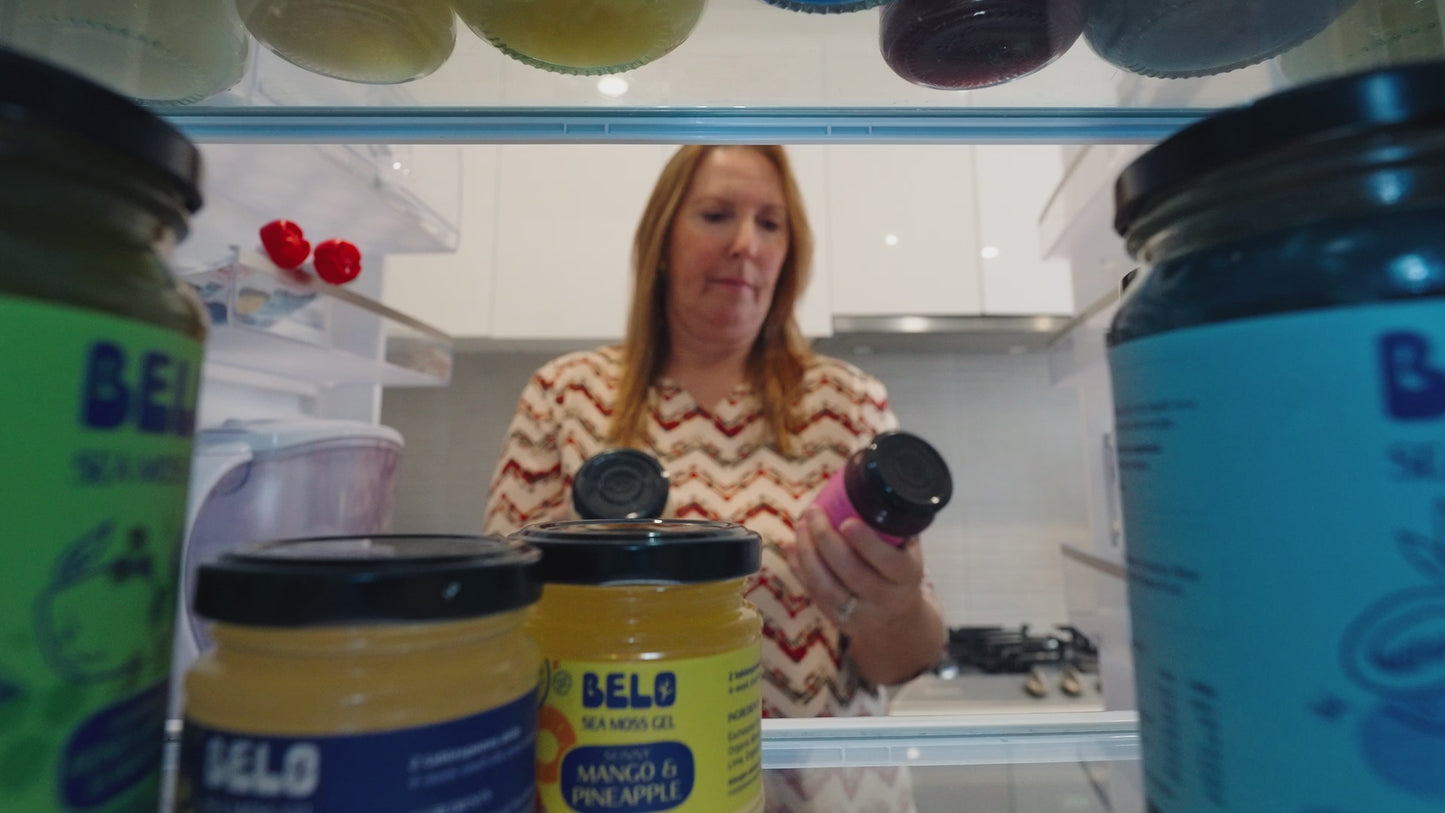
We’ve crafted the signature sea moss formula, pure, potent, and maximally absorbed, with 70% more sea moss, a 12-week shelf life in the fridge, and organic, science-backed ingredients, no nasties.


(Belo was formally called Everboost - Same Quality. Different Name.)
Overall rating: 4.7 / 5 from 445 reviews.

So pleased + thankful to God for Belo Sea Moss Gel that was shared by a Christian friend who got gr8 relief from her Chronic Fatigue when nothing else had helped. Now after only 1 month of taking Sea Moss I am pleased to say that my over 10 years of suffering from Chronic Fatigue my energy levels + enthusiasm have improved. I do not feel like a "WALKING CORPSE!!".... or have to "HOLD" the couch down for long lengths of time throughout the day. My GP even gave me the OK to try it even though I have had an underactive thyroid for years. My gut + appetite are better + the heartburn I was experiencing on a regular basis has stopped. Many thanks to you for this excellent, easy to take, naturally healthy product that is helping my health so much and giving me the ability to maintain wellness instead of taking Prescription Medication.

Love the flavours, tastes great, feeling more balanced inside my body, with every day I have it.

Sea moss taste is real I really like the taste . I love it

I absolutely love the belo sea moss gels, they taste great and also feel like they line my stomach and provide nourishment from the inside out! :)

I got the sample pack to try. Berry, matcha, lime and the other was pineapple I think. I’ve brought sea moss from other places and the texture/taste has been awful. The berry flavour is DELICIOUS and the texture is really nice too! I only have the matcha and lime left but I’ll definitely be buying the berry one again!

I really like this stuff but my favourite 🤩 taste is the berries and pineapple 🍍 flavour. I will buy again.

I got the sample pack and I am glad I did. It was a great way to try all the flavours and see what suits me. I have definitely noticed the difference in my tummy with having it but nothing else yet. I have just placed an order for 3 full sized jars to see how I go. Not sure at this stage if the cost is sustainable

I got the starter pack as a trial and I'm so glad I did! I wanted to sample a few to decide which would be my favourite and I have to say so far all have been tasty but I'm enjoying the mixed berry one the most. Will buy more!

Love this stuff! Tastes delish. Wish I had ordered the large matcha flavour lol as it’s AMAZING!!
Belo Sea Moss Gel - Starter Pack

My husband and I love these, his favourite is the mixed berry flavour and mine in mango and pineapple or the matcha one. The texture isn’t as “chicken fat” as other brands either
Belo Sea Moss Gel - Starter Pack

I love the fact you could buy a sample pack to see if you like the texture and taste. My favourite flavour was lime, I wasn't fussed on the others. I haven't noticed any benefits so far, in terms of reduced inflammation (it's only been a couple of weeks). I plan to buy a full size jar of the lime, so I can observe any noticeable changes.

This seamoss was the most delicious seamoss I’ve ever tasted! I’ve had many many different brands and nobody comes close to ur guys seamoss. can’t wait to purchase again!!
Belo Sea Moss Gel - Starter Pack

Feel like I can fly
Belo Sea Moss Gel - Starter Pack

Love each of these flavours. Such a beneficial products for the body. One of those things you don’t know how much you need it until you have run out of it. Definitely notice a difference in the way I feel when I’m taking it

On my 4th bottle! It’s really yummy and easy to eat. No weird taste whatsoever and can mix in my smoothies! Will buy again

My 7 year old son love his Belo Seamoss

We have been using this for over a month now (purchased larger jars after tasting the flavours, mango pineapple and mixed berries are our favourites) and our daughter has in the past had gut issues. Since starting this we have seen a significant change in this (especially this last week) to the point where medical intervention is no longer necessary! And her body is now functioning as it should in this area! I can’t thank you all enough!
Belo Sea Moss Gel - Starter Pack

This is a great introduction to trying the various flavours before buying the bigger jar. I enjoyed tasting them and knowing they were full of goodies for my inner health.
Belo Sea Moss Gel - Starter Pack

I have known about sea moss benefits for years but it wasn't easy to source and prepare. I was pleased to discover your products! I love it and will buy more! I also shared the info on my newsletter and Facebook.
Belo Sea Moss Gel - Starter Pack

Great
Belo Sea Moss Gel - Starter Pack

My skin looks so clear compared to before taking the sea moss! It’s literally glowing and results happen quick.
Belo Sea Moss Gel - Starter Pack

I loved it all but my fav is Fresh mixed berries and cool blue spirunila & coconut. Belo never disappoints. I m ordering more in future.
Belo Sea Moss Gel - Starter Pack

Yummy Belo sea moss gel, was a great surprise in taste and ease of dosing. I really feel like this is the supplement I can swallow easily and look forward to. I have multiple health issues and have loads of pill supplements to take and this has replaced a few at least. I’m even getting my very fussy daughter (11 years old) to take it . Very pleased and will continue this amazing product.

Taste great and didn't take long for the order to arrive

Love the taste, feel I have more energy

Belo sea moss gel is becoming a part of my morning supplement routine, I’ve been taking it consistently for just over a week now trialing the mini flavours pack to see which flavour I like best

Love the tasting pack, it was great to be able to see which of the flavours I wanted to purchase more of. Lived the berry flavour ❤️

We finish all of them. It’s really good

I love the product. It tastes great! easy and quick. I feel a sense of well-being and health. I'm not sure why but my hair feels good. Just an overall healthy feeling and energy.

Trial packs are the best way to work out your favourite flavours. A really great idea and shipping didn’t take long at all. The quality is without fault and you can see their passion for their product.

My favourite flavour is the classic then coming in close second would have to be tropical I've felt a change in my energy boost just after the first week! Highly recommend 👌 💕
Everboost Sea Moss Gel Starter Pack

I love it the taste and its value for money and my health. I will recommend the ever boost. I will buy it again. Thank you
Everboost Sea Moss Gel Starter Pack

Very yummy I very love it all flavours. Easy to eat. and my favourite is tropical and matcha.
Everboost Sea Moss Gel Starter Pack

This is our favourite tropical sea moss. So nice 🙂
Everboost Sea Moss Gel Starter Pack

This is the first time EVER trying this product and i have noticed a big difference with my skin and gut health. I highly recommend 👌
Everboost Sea Moss Gel Starter Pack

Finished my little sample jars and now I’m onto the big boys.👍🏻 Love them and the extra bonus, they taste great ☺️
Everboost Sea Moss Gel Starter Pack

I was having trouble with stomach and digestive problems for 18 months and tried all sorts of different things but ever boost sea moss seems to have worked. The taste and the texture is unique but once you get used to it after the first couple of goes it is amazing and the results were almost straight away. thank you guys at ever boost I’m sure glad I discovered you. Kind regards Benjamin Adsett

Just got the package today..... it's Delicious, I like the different flavours. Glad it's healthy as well lol
Everboost Sea Moss Gel Starter Pack

Hey everyone, me sorry for what I am about to say, but in a good way, so hear me out, do not get the sample pack, they just ain't big enough ;) just get the value pack, to get to know what is your favourite, and 2 of them! :)

Makes me feel young and bedroom time has significantly improved.